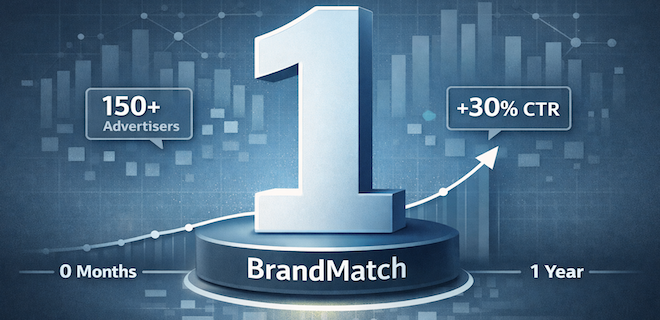
BrandMatch, a generative AI-powered contextual targeting tool developed by The New York Times, just celebrated its first birthday. Here’s to surviving the “terrible twos.”
A lot of publishers have tried plugging artificial intelligence into their advertising machine, but most are still waiting to see what really works in the wild.
The New York Times now has a full year under its belt running BrandMatch, which uses AI to sift through the NYT’s first-party data (think reading habits, clicks, and content preferences) and match ad campaigns to real audience interests.
I caught up with Valerio Poce, the NYT’s executive director of ad product marketing, to see what’s working, what’s hype and what’s ahead.
BrandMatch at 1
First, the results.
“In the first year of operation, we’ve seen more than 150 unique clients adopting the technology, with the majority of them coming back for a second or a third campaign,” Poce told AdMonsters.
That’s notable loyalty.
Advertisers are also seeing performance improve.
Poce added that the Times has seen average click-through rates increase by 30% compared to other targeting methods. With campaigns using video assets, it’s seen video completion rates increase by about 30% on average, while many campaigns achieved click-through rates of over 1%.
Going Beyond Contextual Signals
But how does it work?
BrandMatch combines contextual signals with detailed audience data to create highly specific campaign segments.
“We have evolved a little bit past the paradigm of audience and contextual targeting,” Poce explained. “BrandMatch is really, in that sense, a hybrid solution.” Instead of tagging articles by topic, BrandMatch connects advertisers with audiences who are reading content that reflects their campaign goals.
Take a recent campaign for Crown Publishing. Traditionally, a book publisher’s campaign with the NYT would rely on tried-and-true segments, such as “book lovers” or a general lifestyle topic, grouping readers simply because they share a broad common interest.
BrandMatch, however, lets them go deeper. For Crown Publishing, “we were able to use the actual plots of individual books to build a contextual and audience target specific for that campaign,” Poce said.
Rather than simply targeting readers who like books, NYT created custom audience groups for specific titles—for example, building a segment of readers whose browsing or reading history suggests they’d be open to connecting with the themes of a certain novel or nonfiction work.
“Usually, a publishing client would target more or less the same audience and context for any book that they would advertise,” said Poce. “With BrandMatch, they can actually build that very specific targeting segment for the specific book, and that is what drives performance.”
Expanding the Toolbox
But NYT isn’t content to let BrandMatch just run standard campaigns. Poce and his team are actively working to broaden what the tool can do, including finding new ways to reach audiences and unlocking more value for advertisers.
Sponsorship is a big one.
“We’ve been focused on increasing the value of our editorial advertising sponsorships in two ways,” Poce said. One is more standard, involving audience extension to reach people with similar interests. The other is more innovative.
“If an editorial sponsorship is sold out,” Poce said, “we can build something similar, which is a collection of content and audiences that are a good proxy for what you want.”
The Times is only just starting to roll this out, but early runs—like a recent campaign for the Belmont luxury train, which used content from NYT’s own creative studio—are already showing the potential for broader applications.
And BrandMatch is now also available programmatically as well through private marketplace deals.
“Some clients just prefer to transact programmatically,” Poce said.
The process takes some collaboration with the NYT team to set up, but the flexibility advertisers get once that’s done is worth it, Poce said.
Lessons Learned and Industry Advice
Looking back on BrandMatch’s first year, Poce said the NYT learned that creating a successful AI product requires rethinking internal workflows.
The NYT had to adapt how it ingests information from advertisers, how that info feeds into BrandMatch and how it fits into its planning and operations systems.
For publishers watching from the sidelines, Poce emphasized the importance of intent and process over buzz. “Have a goal in mind when exploring new technologies,” Poce said.
“Embrace the new technology, but really focus on the tangible impact that you’re trying to drive,” he said. “We started looking at Gen AI as an emerging technology, and we were very laser-focused on improving our targeting systems and our ad performance.”