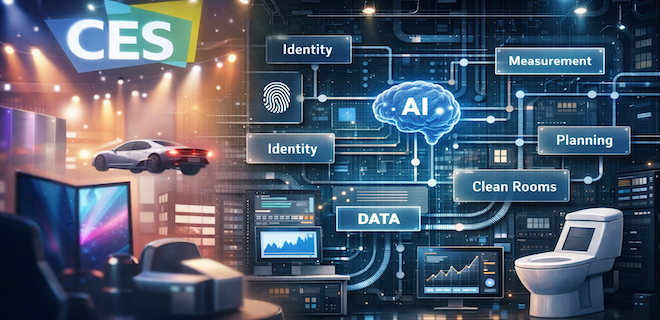
It’s easy to get distracted by the flashy – and sometimes wacky – “innovations” on display at the Consumer and Electronics Show (CES) in Las Vegas.
You know, bendable screens, flying cars and a toilet computer that analyzes bowel movements. (Really.)
While I didn’t attend CES this year, I got some insights from industry experts who were on the ground. According to them, the showroom floor and stages were dominated by breakthroughs far less flashy yet far more consequential. I’m talking about systems, the backend. AI-powered systems. New measurement systems. Identity systems. End-to-end systems promising less friction, more control and better outcomes for the ad ops folks.
Across CES, the message was consistent: Advertising is getting more automated and more interconnected.
But, as always, who gets to be in control and on what terms depends on where one sits in the ecosystem.
Large platforms showcased tightly integrated stacks designed to remove complexity, while publishers and their ad tech partners talked openly about eroding traffic, unstable signals and the urgent need to protect revenue and audience relationships in a zero-click era.
A Single View of Campaign Performance
One of the clearest examples of this “everything is connected” vision was articulated by Disney Advertising, which used CES as an opportunity to outline how planning, creative, identity and measurement are being unified into a single advertising system.
Disney Compass sits at the center, combining media planning, data collaboration and measurement on one platform. Advertisers can plan campaigns, securely collaborate using data clean rooms (controlled environments where data can be matched without actually being shared) and analyze performance in one place.
This year, Disney also announced a new Brand Impact Metric that aims to connect traditionally siloed signals—such as attention, brand health, search behavior and attribution—into a single view. Rather than treating brand and performance as separate goals, the metric shows how they work together to drive outcomes.
“As many of these outcomes happen outside of the campaign window, this metric will inform more actionable optimizations that help highlight the variables that drive sustained brand growth, whether for a new or established brand,” said Nick Winfrey, VP of data and measurement sciences, Disney.
AI is doing much of the heavy lifting. Disney also outlined agentic planning tools that can turn an RFP into a media plan in hours instead of weeks. Disney showcased an AI-assisted creative review tool that accelerates campaigns and generative video tools for efficiently producing multiple CTV-ready assets.
Disney’s pitch is straightforward: less fragmentation and clearer outcomes. The question now is whether the tools can produce compelling results.
Meanwhile, on the Open Web: Fewer Clicks and Messier Signals
But outside the big platforms, the tone at CES was far more pragmatic, as industry players focused on the many issues facing publishers.
“More than half of Google searches now end without a click,” Samir Chabab, VP of global marketing at Ogury told AdMonsters.
AI-powered summaries and zero-click experiences continue to drain traffic from publisher sites, with the result that publishers can no longer rely on search as a dependable traffic engine.
In response, publishers are treating editorial less as a standalone function and more as a distribution engine, extending content across newsletters, podcasts, social platforms, mobile apps and CTV to regain control over audience relationships.
But traffic isn’t the only thing under pressure. Signal quality is, too.
“When only $0.03 of every $1 hits the right audience, stability in audience identification becomes nonnegotiable,” Charlie Johnson, VP international at Digital Envoy told AdMonsters.
Without consistent identifiers, publishers and buyers alike struggle to target, measure and optimize effectively.
That’s why more focus is shifting upstream in the auction process, some industry experts told AdMonsters.
“Publishers are now focused on enriching bids with higher-quality signals as far upstream as possible,” said Lisa Abousaleh, SVP of partnerships at ID5.
Enriching the bidstream earlier—before auctions are finalized—improves demand performance and helps publishers maintain control over how their data is used.
Buyers, meanwhile, want to move faster without increasing risk. Stacy Bohrer, SVP of buyer development at OpenX, said many great ideas stall because the path from insight to activation is too slow or complex.
What became clear across CES is that fragmentation is an industrywide problem. As signals degrade, platforms that can unify planning and measurement under one roof are positioning themselves as a counterweight to that complexity. That context helps explain why media owners like Disney and others are leaning heavily into integrated stacks.