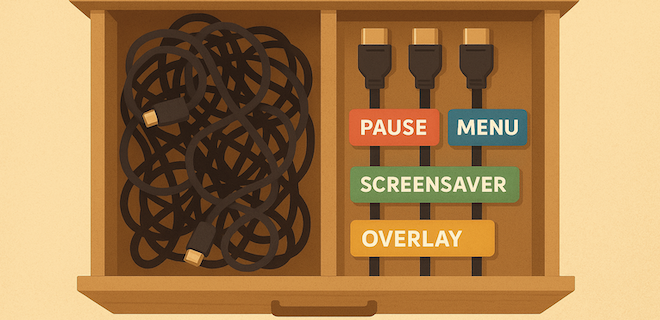
The IAB Tech Lab’s new CTV Ad Portfolio and programmatic guidance aims to bring unified definitions and cleaner transactions to one of streaming’s most chaotic ad environments.
Just when we thought 2025 might coast into a quiet landing, the news cycle dropped a blockbuster. Netflix is acquiring HBO and Warner Bros. in what might be one of the biggest streaming TV mergers ever.
Most of the world is focused on what this deal means for programming, platform bundles, and whose password-sharing rules will reign supreme. But, while the consolidation of streaming platforms simplifies the fragmented CTV viewing experience, the ad ecosystem is working on its own version of simplification. Not through mergers, but through clearer standards.
Which brings us to the latest from IAB Tech Lab: the release of its CTV Ad Portfolio and an update to its Guide to Programmatic CTV. The CTV Ad Portfolio standardizes six popular CTV ad formats, including pause ads, menu ads, screensavers, in-scene placements, squeezebacks, and overlays. And the updated Guide to Programmatic CTV offers guidance for how to consistently transact on these formats, and also includes new OpenRTB support for pause and menu ads. Both updates are open to feedback from the industry until the end of January.
Think of the release of these new standards as less like a splashy product rollout and more like someone finally labeling the dozens of identical-looking cables in your office drawer. It’s a necessary and overdue effort to get the CTV market on the same page and using the same definitions.
Why CTV Needed a Cleanup Crew
CTV now accounts for most TV viewing in the U.S., but the ecosystem powering it has been more chaotic than anyone would prefer.
Many publishers and platforms have built similar ad experiences using the same ad formats, but each with its own naming conventions, specs, and implementation rules. Meanwhile, buyers tried to transact on these formats programmatically without a reliable sense of what they were actually buying.
To better understand this dynamic, the IAB Tech Lab launched the Ad Format Hero initiative last October, collecting more than 100 real-world format submissions from across the industry. Jill Wittkopp, VP of Product at IAB Tech Lab, told AdMonsters that the submissions highlighted the industry’s need for clearer, more unified definitions for emerging CTV formats.
“There was a strong push for formats that create incremental, high-value opportunities outside traditional ad pods,” Wittkopp said. “We focused on the formats that consistently surfaced across submissions.”
Here are those formats, as simply defined by the IAB Tech Lab:
- Pause ads: Appear when a viewer pauses the content.
- Menu ads: Shown on the navigation screens of streaming apps.
- Screensaver ads: Displayed during periods of inactivity.
- In-scene ads: Integrated naturally into the show environment.
- Squeezebacks: Where the video shrinks, and an ad displays beside it.
- Overlays: Light graphical elements displayed over the content.
If these formats feel familiar, that’s the point. They’ve existed for years. They just were labeled differently across programmatic platforms. But, if the platforms adopt these new standardized definitions and integrate them into their OpenRTB specs, marketers will now know exactly what they’re bidding on.
Updated Programmatic CTV Guidance
The IAB Tech Lab also released an update to its Guide to Programmatic CTV with new OpenRTB support for pause and menu ads.
For anyone newer to the technical side of digital advertising, here’s the plain-English version. OpenRTB is the protocol that enables ad systems to communicate automatically during programmatic buying. The OpenRTB protocol is overseen by the IAB Tech Lab.
If a platform wants to request a certain format, or a buyer wants to tell the system, “Only bid if it’s a pause ad,” OpenRTB is the shared language that makes that possible. OpenRTB updates directly affect how smoothly a format can be bought and sold across devices and platforms.
The Tech Lab prioritized pause and menu ad formats in this update because they’re already widely adopted, highly in demand and generate strong revenue for publishers.
“Pause and menu were already among the most widely deployed and highest-value CTV formats, but every publisher handled them differently,” said Wittkopp. “That lack of consistency made it hard for buyers to request or transact them reliably and often caused mismatches in creative expectations.”
The updated specifications give everyone in the supply chain — buyers, publishers, SSPs, DSPs, platforms — a shared set of definitions so the formats behave consistently. And they clarify how these formats must be labeled in OpenRTB bid requests. That means fewer headaches, fewer broken creatives, and fewer emails with subject lines like “Quick question about your pause ad requirements” that are never actually quick to resolve.
“It won’t eliminate all friction overnight,” Wittkopp said, “but it should meaningfully smooth day-to-day execution as adoption grows. That operational lift is what makes it realistic for the industry to scale more advanced CTV ad experiences heading into 2026.”
Publishers Weigh In
Pubs agree with that assessment.
Gianluca Milano, head of Ad Experience Product at Disney, emphasized that interoperability is essential for scaling more advanced CTV experiences.
“These new standards will benefit the entire ecosystem by establishing a consistent framework for advanced ad formats to scale across platforms and buying channels, empowering advertisers with captivating and engaging experiences,” Milano said.
Consistent standards across CTV environments help make premium video inventory more accessible and easier to activate, added Ryan McConville, Chief Product Officer and EVP of Ad Products and Solutions at NBCU. Such standardization is especially relevant for publishers who often lose time (and potential revenue) to broken creatives or unclear format expectations.
Now that both sides of the ecosystem have a clearer path to transact on CTV inventory, it should help publishers unlock more value from emerging CTV ad formats. But, as with all IAB Tech Lab standards, the real impact will depend on how quickly platforms adopt the new specs next year.